
Cannabis Strength Guide by Master Dispensary
Posted by Master Dispensary Team on May 19th 2026
Cannabis strength is not one-size-fits-all. To compare products accurately, look beyond a single THC percentage: the amount per serving, product format, cannabinoid content, and individual sensitivity all matter. This guide explains what potency labels mean, why edibles and inhaled products cannot be compared directly, and how to read lab reports without confusing strength with quality.
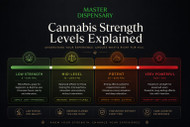
Cannabis Strength Levels: What Do Low, Medium, Potent, and Very Powerful Mean?
Retailers sometimes use descriptive categories such as Low Strength, Mid-Level, Potent, and Very Powerful to help customers compare products. These are not standardized medical or scientific dosing categories. A label like “mid-level” may mean something different for gummies, flower, and concentrates.
| Descriptive tier | What it signals | What to verify |
|---|---|---|
| Low Strength | Relatively lower THC within the same product format | THC per serving, CBD content, serving size |
| Mid-Level | Intermediate concentration compared with similar products | Units on the label and actual dose |
| Potent | Higher THC concentration or serving amount | Impairment risk, serving size, lab results |
| Very Powerful | Highly concentrated or high-THC products | Greater risk of adverse effects; especially important to avoid confusing a package total with one serving |
Key distinction: 20% THC flower is not equivalent to a 20 mg THC edible. One is a concentration by weight; the other is a mass per serving. There is no reliable single conversion that predicts the same experience across formats.
How to Read Cannabis Potency Labels
Edibles: milligrams per serving vs. per package
A gummy package might list total THC for the container and a smaller amount for each piece. Always distinguish these numbers. Public-health guidance for people who choose to use THC edibles emphasizes lower amounts: Health Canada recommends looking for 2.5 mg THC or less when minimizing risks, and notes that full effects may take up to four hours. This is a harm-reduction reference, not a universal safe dose.
Flower: percentage by weight
THC percentage describes how much THC is present relative to the product's weight. Flower labels may also show THCA, which can convert to THC when heated. A percentage does not reveal how much a person actually inhales or how their body responds.
Vapes and concentrates: concentration is not a serving
Vape and concentrate labels commonly show a percentage and total package contents. These help compare formulations, but do not provide a precise dose per inhalation. Higher concentrations can increase the risk of impairment and other adverse effects.
Why the Same THC Amount Can Affect People Differently
Effects vary with prior cannabis exposure, individual sensitivity, product composition, health conditions, medications, and method of consumption. Inhaled cannabinoids generally act faster than edibles. Swallowed THC undergoes metabolism, including conversion to 11-hydroxy-THC, and edible effects can be delayed and longer lasting.
Certificates of Analysis (COAs): What Should You Check?
An independent laboratory report can help confirm what is in a specific product or batch. When available, check the following:
- Product and batch match: The report should correspond to the item being considered, not merely the same brand.
- Cannabinoid measurements: Look for THC, THCA, CBD, and other cannabinoids where relevant, including the units used.
- Contaminant screening: Check for reported testing of pesticides, heavy metals, residual solvents, and microbial contamination where applicable.
- Report date and lab: Look for an identifiable laboratory and current batch information.
A COA helps assess test results for the sampled batch, but it does not by itself prove that a product is safe for everyone, medically effective, or legal in every jurisdiction.
Does the Entourage Effect Make Cannabis Stronger?
The entourage effect is a hypothesis that cannabinoids and other plant compounds, including terpenes, may interact to alter certain effects. It is an active research area, but convincing evidence for predictable, clinically meaningful interactions in humans remains limited. Terpene profiles can describe aroma and chemical composition; they should not be treated as a reliable formula for predicting intensity or a guaranteed experience.
Bottom line: a higher THC number does not automatically mean a higher-quality product, and a terpene label cannot replace dose information or reliable testing.
Frequently Asked Questions About Cannabis Strength
What is the difference between THC percentage and THC milligrams?
Percentage expresses concentration relative to weight; milligrams describe an amount. Read the label carefully to distinguish total package THC from THC per serving.
Are edibles stronger than flower?
They can feel different because THC is absorbed and metabolized differently after swallowing. Effects from edibles are often delayed and may last longer. There is no universal equivalent dose between formats.
Is higher THC always better?
No. Higher THC exposure can increase impairment and adverse-effect risks. Product quality also depends on accurate labeling, contaminants testing, manufacturing practices, and suitability for the individual.
What should someone new to cannabis know?
No method is risk-free. Public-health guidance emphasizes avoiding high-THC products, understanding delayed effects with edibles, and not combining cannabis with driving or other safety-sensitive activities.
Can I order the same product in every state?
Not necessarily. Product availability and legal restrictions vary by jurisdiction and product type. Always check current local rules and the store's shipping eligibility before ordering.
Sources and Further Reading
- Health Canada: Cannabis — lower your risks
- CDC: Cannabis and poisoning, including edibles
- Health Canada: What you need to know if you choose to consume cannabis
- Scientific review: THC interactions with other cannabis constituents
Educational content only; not medical or legal advice. Availability, shipping rules, and product composition can change. For adults of legal age where permitted.